
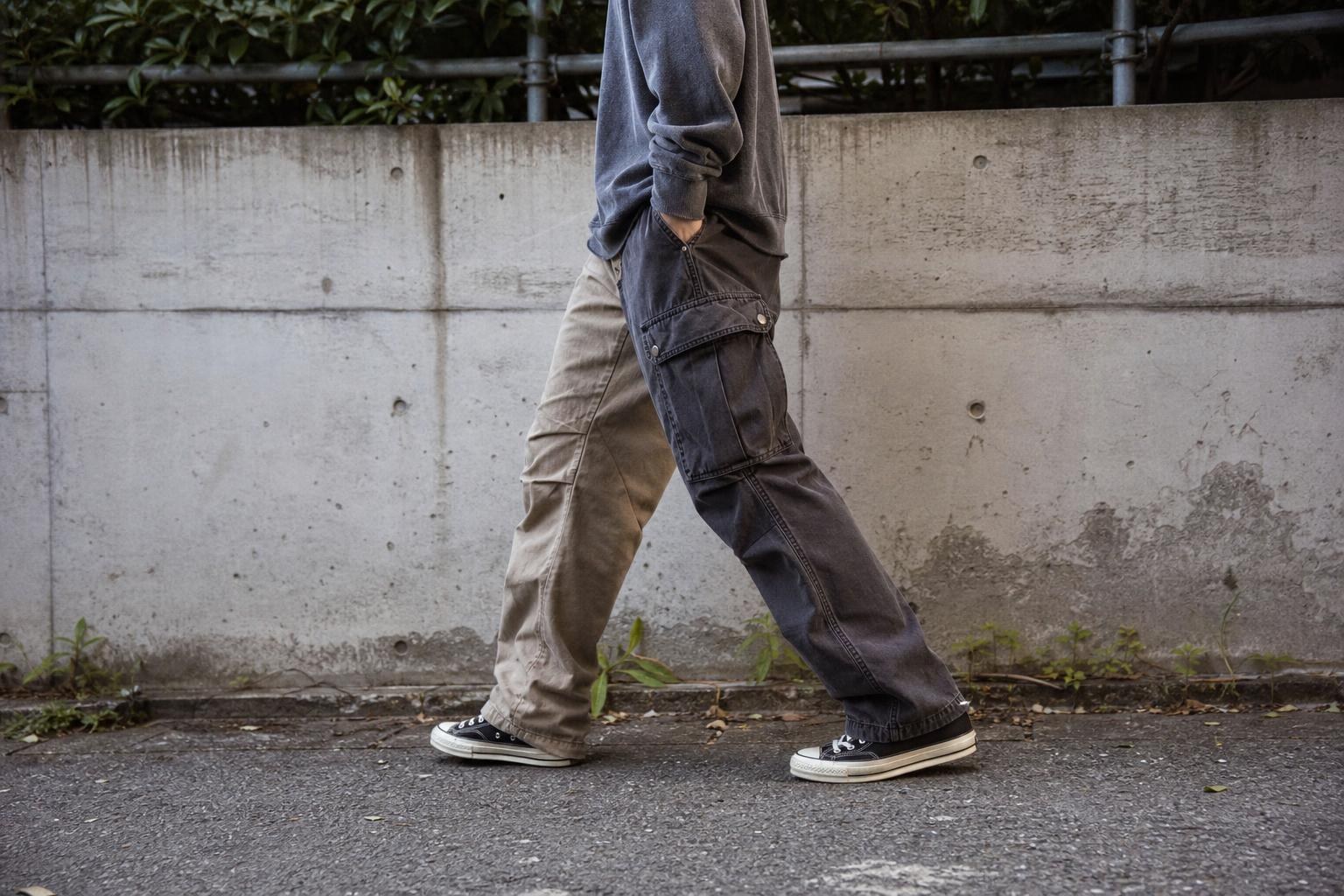
Few garments from the mid-2000s Japanese fashion explosion carry the mythic weight of the Number (N)ine hybrid cargo pants from 2005. Born from Takahiro Miyashita’s obsession with rock music, American counterculture, and the tension between luxury and decay, these pants became one of the most recognizable pieces in archival menswear. They weren’t just cargo pants with some extra stitching. They were a thesis statement about what men’s clothing could become when a designer stopped caring about convention and started building from emotion. Two decades later, they remain a benchmark for collectors and a reference point for designers worldwide. Understanding why requires looking at the collection they came from, the construction choices that made them unique, and the cultural moment they helped define. This is the story of how a pair of pants became a monument. ## The Genesis of Takahiro Miyashita’s ‘The High Streets’ Collection ### Autumn/Winter 2005: A Fusion of Grunge and Military Aesthetics Takahiro Miyashita’s Autumn/Winter 2005 collection, titled “The High Streets,” stands as the creative peak of Number (N)ine’s run. The collection drew from a deep well of references: 1990s Pacific Northwest grunge, Vietnam-era military surplus, British punk, and the worn-in textures of American workwear. Miyashita presented the collection in Paris, where it stunned editors and buyers who had grown accustomed to cleaner European tailoring. The show featured models in layered, deconstructed outfits that looked like they’d been pulled from a thrift store in some alternate universe where everything was designed by a genius. The hybrid cargo pants emerged as a standout piece from this lineup. They captured the collection’s central tension: the collision between something rugged and utilitarian and something soft and intimate. Military cargo pockets sat alongside sweatpant-inspired ribbed cuffs. Distressed surfaces met deliberate, almost couture-level construction. The result was a garment that felt simultaneously thrown together and meticulously planned, which was exactly the paradox Miyashita was chasing. ### The Influence of Kurt Cobain and Portland Culture Miyashita never hid his obsession with Kurt Cobain. Across multiple seasons, Cobain’s aesthetic served as a spiritual guide for Number (N)ine’s design language. The 2005 collection channeled this influence through specific choices: oversized flannel shirts, destroyed knitwear, and pants that looked like they’d survived years of touring. Cobain’s habit of mixing thrift store military pieces with soft, comfortable basics directly informed the hybrid cargo concept. Portland and Seattle’s grunge scenes of the early 1990s provided the cultural backdrop. Miyashita studied how musicians in those cities dressed out of necessity rather than fashion, layering army surplus jackets over thermal underwear and pairing combat boots with pajama pants. He translated that instinct into high fashion, treating the hybrid cargos as a distillation of that ethos. The pants weren’t referencing grunge in a superficial way. They internalized its logic: comfort matters, wear and tear tells a story, and the boundary between loungewear and outerwear is arbitrary. ## Design Anatomy of the 2005 Hybrid Cargo Pants ### Structural Innovation: Combining Sweatpants and Cargo Trousers What made these pants genuinely unusual was their construction. The upper portion used a heavier cotton twill typical of military cargo trousers, complete with oversized flap pockets, reinforced stitching, and a slightly tapered leg. Below the knee, the fabric transitioned into a softer, jersey-like material with ribbed ankle cuffs pulled straight from sweatpant design. This wasn’t a gimmick. The transition between fabrics was handled with visible seaming that became part of the design language, drawing attention to the hybrid nature rather than hiding it. The waistband offered another point of contrast. Some versions featured a drawstring waist reminiscent of athletic wear, while others used a traditional button-fly closure. The fit sat lower on the hips than standard military trousers, giving them a slouchy, relaxed drape that matched the collection’s overall silhouette. Miyashita understood that the way a garment hangs on the body communicates as much as its surface details. ### Signature Details: Distressing, Ribbing, and Hardware The details on these pants reward close inspection. Distressing appeared in specific, intentional locations: around the pocket edges, along the seams, and at stress points where real wear would naturally occur. This wasn’t random shredding. Miyashita’s team applied wear patterns that mimicked years of actual use, giving new garments the patina of lived experience. Hardware choices reflected the same thoughtfulness. Matte black snaps replaced standard shiny buttons on the cargo pockets. Zippers were heavy-gauge but understated, often partially hidden behind fabric folds. The ribbed cuffs at the ankle used a slightly different knit tension than the waistband, creating a subtle textural variation that most people would never consciously notice but that contributed to the overall feeling of the piece. These micro-decisions separated Number (N)ine’s work from the dozens of brands attempting similar military-meets-streetwear fusions during the same period. ## Cultural Impact and the Rise of Ura-Harajuku Fashion ### Pioneering the ‘Luxury Grunge’ Movement Number (N)ine operated within a specific ecosystem: the Ura-Harajuku scene, a loose network of independent Japanese designers who worked from small shops in the backstreets of Tokyo’s Harajuku district. Brands like Undercover, A Bathing Ape, and Hysteric Glamour were neighbors and peers. But Miyashita occupied a unique position within this group. His work was more emotionally raw, more directly tied to music, and more willing to destroy expensive materials in pursuit of a feeling. The 2005 hybrid cargos helped crystallize what critics later called “luxury grunge,” a term that described the practice of applying haute couture techniques to garments inspired by poverty, rebellion, and decay. This wasn’t new territory entirely: Martin Margiela and Rei Kawakubo had explored similar ideas. But Miyashita brought a specifically American rock-and-roll sensibility that resonated with a younger audience. The pants became a symbol of this movement, showing up in street style photography from Tokyo to New York throughout 2005 and 2006. ### The Role of Number (N)ine in Shaping Modern Menswear Silhouettes The broader influence of these hybrid cargos on menswear silhouettes is hard to overstate. Before Number (N)ine popularized the idea of mixing athletic and military elements in a single garment, most designers treated these as separate categories. You wore sweatpants at home and cargo pants on the street. The hybrid approach suggested that these boundaries were artificial, and that a single garment could serve multiple functions while looking intentional. This thinking directly influenced the rise of athleisure and technical fashion in the 2010s. Designers at Rick Owens, Fear of God, and later brands openly cited Miyashita’s work as a reference point. The specific detail of ribbed cuffs on non-athletic pants became a widespread design choice that can be traced back to pieces like the 2005 cargos. Jerry Lorenzo has spoken publicly about Number (N)ine’s influence on Fear of God’s early collections, and the DNA is visible in everything from drop-crotch joggers to hybrid outerwear. ## Legacy in the Archival Fashion Market ### Rarity and Resale Value in the Modern Era Number (N)ine ceased operations in 2009 when Miyashita shuttered the label, making every piece from the brand’s run a finite resource. The 2005 hybrid cargo pants are among the most sought-after items in the archival market. As of 2026, authenticated pairs in good condition regularly sell for $2,000 to $4,500 on platforms like Grailed, Yahoo Japan Auctions, and specialized archival dealers. Exceptional examples in unworn condition have crossed the $6,000 threshold. Several factors drive these prices. Production numbers were always small, as Number (N)ine operated as an independent label without the manufacturing scale of larger fashion houses. The pants also suffered from their own success: people wore them hard, meaning surviving examples in clean condition are genuinely rare. The collector community around Number (N)ine has grown steadily since the brand’s closure, with dedicated forums, Instagram accounts, and Discord servers tracking sales and authenticating pieces. ### Influence on Successor Brands like Soloist and Off-White After closing Number (N)ine, Miyashita launched Takahiro Miyashita The Soloist in 2010. The new label carried forward many of the same obsessions but with a more refined, minimal approach. Elements of the hybrid cargo concept reappeared in Soloist collections, though typically in subtler forms: a jogger pant with military-inspired pocket placement, or a trouser with unexpected fabric blocking. Virgil Abloh’s Off-White also showed clear echoes of Number (N)ine’s approach to deconstruction and hybridization, particularly in early collections that mixed industrial hardware with streetwear silhouettes. The practice of combining two garment archetypes into a single piece, which the 2005 cargos exemplified so clearly, became a standard technique across contemporary fashion. Brands from Sacai to Greg Lauren built entire identities around this principle. ## Identifying Authentic Vintage Hybrid Cargos For anyone looking to buy a pair of these pants in 2026, authentication is critical. The counterfeit market for Number (N)ine pieces has grown alongside prices, and the hybrid cargos from 2005 are among the most frequently replicated items. Start with the label: authentic pieces feature a specific font and tag construction that changed slightly between seasons. The AW2005 tags have a particular weight and texture that reproductions rarely match perfectly. Examine the hardware closely. Original snaps and zippers were sourced from specific Japanese manufacturers and have a distinct feel and finish. The distressing should show variation in depth and pattern rather than uniform abrasion, which is a common tell for factory-reproduced aging. Stitching on genuine pieces uses a specific thread weight and tension, and the seam where the twill transitions to jersey should show careful, slightly irregular handwork rather than machine-perfect uniformity. Buying from established archival dealers with return policies remains the safest approach. Sellers with documented provenance and detailed photographs of interior tags, hardware stamps, and fabric close-ups are worth the premium they charge. If a deal looks too good, it almost certainly is. The Number (N)ine hybrid cargo pants from 2005 represent something rare in fashion: a single garment that captured an entire creative philosophy. They were the physical embodiment of Miyashita’s belief that clothing should carry emotional weight, that comfort and beauty aren’t opposites, and that the most interesting designs happen at the intersection of things that shouldn’t go together. Twenty-one years after their debut, they continue to shape how designers think about construction, hybridization, and the relationship between high fashion and subcultural style. For collectors, they’re a grail. For designers, they’re a lesson. For everyone else, they’re proof that a pair of pants can mean something.
The History of the Number (N)ine 2005 Hybrid Cargo Pants
 PANTS
PANTS

コメント