
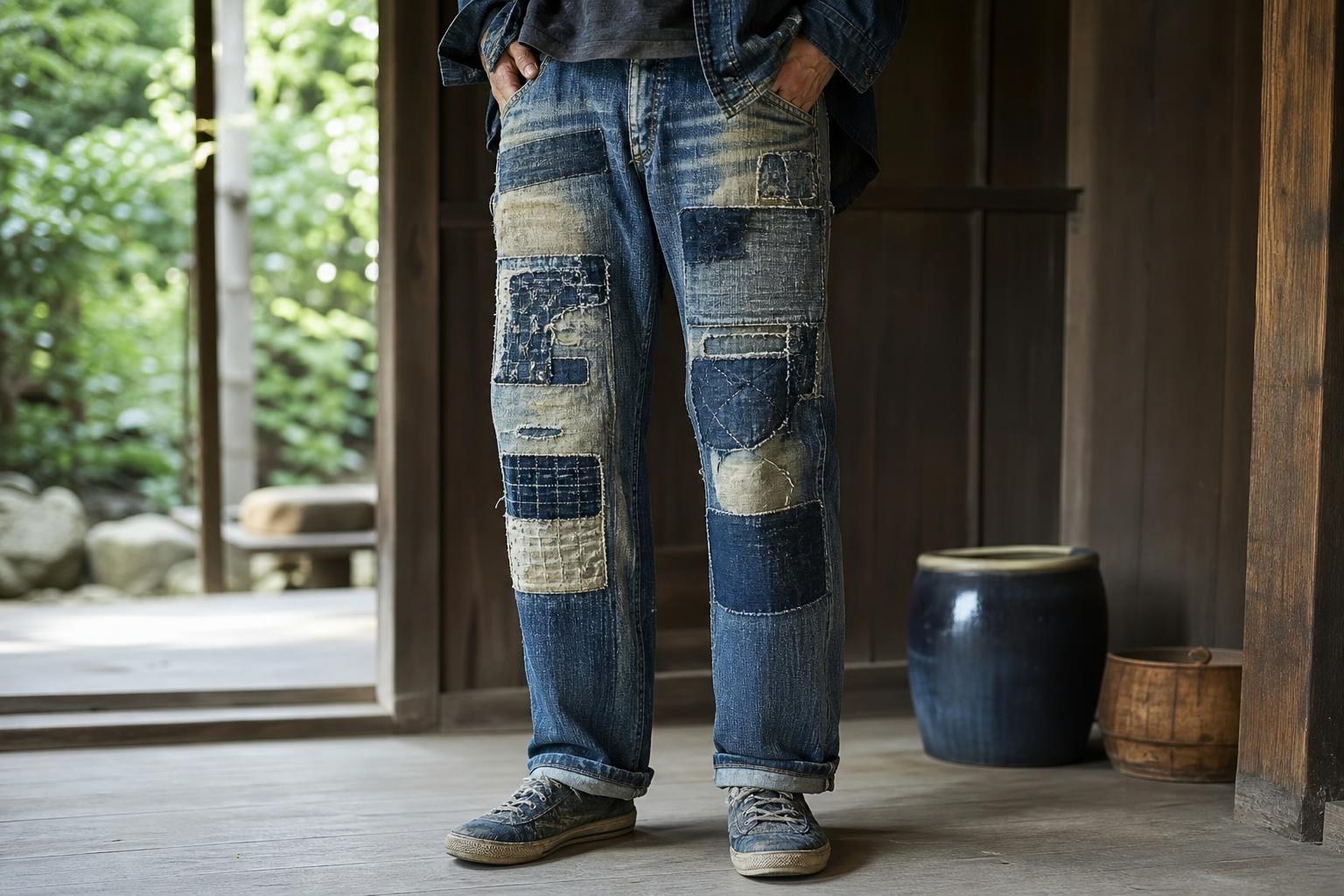
Few garments tell a story quite like a pair of jeans held together by decades of hand-stitching, mismatched indigo patches, and the philosophy that nothing should ever be thrown away. Kapital, the Okayama-based label founded by Toshikiyo Hirata in 1984, has turned this philosophy into wearable art. Their boro patchwork denim jeans are not mass-produced fashion items: they are textile narratives, each one carrying the weight of Japanese craft traditions that stretch back centuries. What makes these pieces so compelling isn’t just the way they look, though they are visually striking. It’s the tension between destruction and creation, between something worn out and something made whole again. In a fashion climate increasingly dominated by speed and disposability, Kapital’s approach feels almost radical. These jeans ask you to slow down, to look closer, and to reconsider what “finished” really means. Whether you’re a denim obsessive, a collector of Japanese fashion, or someone who simply appreciates the handmade, understanding how these pieces come together changes the way you see clothing entirely. ## Origins and Philosophy of Kapital Boro Denim ### The Japanese Tradition of Mottainai and Repair The word mottainai carries a meaning that doesn’t translate neatly into English. It expresses a deep regret over waste, a sense that discarding something useful is almost a moral failure. This concept has shaped Japanese material culture for centuries, particularly in rural communities where textiles were precious and labor-intensive to produce. Families would repair garments over generations, layering new fabric onto old, creating what we now call boro: a patchwork born of necessity rather than decoration. Kapital draws directly from this tradition. Their boro denim isn’t trying to look distressed for the sake of trend: it’s channeling an entire worldview about the relationship between people and their possessions. Each patch represents a refusal to discard, and each stitch is a small act of preservation. This philosophy separates Kapital from Western brands that simulate wear. The difference is intent. Simulated distressing says “I want to look like I’ve lived in these.” Boro says “these have lived, and they deserve to keep living.” ### Kojima: The Heartland of Japanese Denim Craft Kapital operates out of Kojima, a district in Okayama Prefecture that has been producing denim since the 1960s. Kojima earned its reputation by studying American selvedge denim manufacturing and then, frankly, surpassing it. The region’s mills developed proprietary weaving techniques, and local artisans perfected dyeing methods that American factories had largely abandoned in favor of cheaper synthetic processes. This geography matters. Kapital isn’t designing in a vacuum: they’re surrounded by some of the world’s most skilled denim craftspeople, indigo dyers, and textile specialists. The brand’s proximity to these resources allows them to source vintage shuttle-loom fabrics, natural indigo dye, and hand-spun cotton that would be nearly impossible to find elsewhere. Kojima gives Kapital both a supply chain and a creative ecosystem that no other location could replicate. ## Mastering the Aesthetic of Imperfection ### Sashiko Stitching Techniques and Patterns Sashiko is the running stitch technique that holds boro patchwork together, and it’s far more complex than it first appears. Originating in northern Japan during the Edo period, sashiko was initially a practical reinforcement method: farmers would stitch through multiple layers of fabric to strengthen work clothes against harsh winters. The geometric patterns that emerged, including persimmon flowers, ocean waves, and interlocking diamonds, were functional before they were beautiful. Kapital’s artisans use traditional sashiko patterns but apply them with a deliberately irregular hand. No two pieces receive identical stitching. Some areas feature dense, tightly packed rows that create an almost quilted texture, while others use sparse, widely spaced stitches that let the underlying denim breathe. This variation is intentional. Perfectly uniform sashiko would undermine the entire aesthetic, which celebrates the evidence of human hands at work. ### The Intersection of Wabi-Sabi and High Fashion Wabi-sabi, the appreciation of impermanence and imperfection, runs through every Kapital boro piece. A frayed edge isn’t a defect: it’s a feature. An uneven dye line isn’t a mistake: it’s proof of organic process. This philosophy sits in direct opposition to luxury fashion’s traditional obsession with flawless construction and pristine finishes. What’s interesting is how the fashion world has come around to this idea. By 2026, major houses from Margiela to Bottega Veneta have incorporated visible mending and raw edges into their collections, but Kapital was doing this decades before it became fashionable. The brand didn’t adapt to a trend: the trend came to them. That authenticity is part of why collectors and designers respect Kapital’s work so deeply. You can’t fake a genuine relationship with these techniques. ## The Meticulous Construction Process ### Sourcing and Aging Vintage Textiles The patches used in Kapital’s boro denim jeans aren’t cut from new fabric. Many come from vintage Japanese textiles: old work shirts, futon covers, tenugui hand towels, and other cotton goods that carry their own histories. Some of these source fabrics are 50 to 100 years old, with fading and wear patterns that simply cannot be manufactured. Kapital’s sourcing team hunts through antique markets, estate sales, and textile dealers across Japan to find suitable materials. The criteria are specific: the fabric must be cotton or a cotton blend, it must have enough structural integrity to be stitched onto denim, and its color must complement the indigo palette. Lighter patches in faded blues and natural whites are especially prized because they create the contrast that makes boro visually dynamic. ### Manual Patchwork and Layering Methods Each pair of Kapital boro jeans is assembled by hand, and the process can take days. Artisans begin with a base pair of denim, typically cut from Kapital’s own selvedge fabric, and then build up layers of patches according to both structural need and visual composition. The layering follows a loose logic: – Larger patches form the foundation, covering areas where the base denim has been intentionally thinned or cut away – Smaller accent patches are placed on top to create depth and textural contrast – Sashiko stitching secures each layer while adding its own decorative element – Some areas receive three or four overlapping layers, creating a thickness that gives the jeans a sculptural quality No template governs this process. Each artisan makes compositional decisions in real time, which is why no two pairs are identical. This handwork is what justifies the price point and what separates genuine Kapital pieces from the imitations that have flooded online marketplaces. ### Indigo Dyeing and Distressing Artistry Kapital uses both natural and synthetic indigo, depending on the line and the desired effect. Natural indigo, derived from the Japanese plant Persicaria tinctoria, produces a deeper, more complex blue that shifts in tone depending on the number of dips and the oxidation time. Some pieces undergo 15 to 20 dipping cycles to achieve their final shade. The distressing process is equally deliberate. Rather than using industrial sandblasting or chemical washes, Kapital’s team creates wear patterns through manual abrasion, stone washing in small batches, and selective sun-fading. The goal is to mimic the kind of wear that develops naturally over years of use, concentrated at stress points like the knees, thighs, and waistband. The result is denim that looks genuinely lived-in from the moment you put it on. ## Defining the Iconic Kountry Line Kapital’s Kountry line is where boro patchwork denim finds its fullest expression. Launched as a sub-label focused on Americana filtered through Japanese craft sensibilities, Kountry takes workwear silhouettes like five-pocket jeans, chore coats, and overalls, and transforms them through boro techniques. The line’s most recognizable pieces are its heavily patched straight-leg and relaxed-fit jeans, which retail between $800 and $2,000 depending on the complexity of the patchwork. What distinguishes Kountry from Kapital’s other lines is the density of handwork. A standard Kapital jean might feature light distressing or a single sashiko-reinforced area. A Kountry piece looks like it has been repaired and rebuilt multiple times over, with patches covering 40 to 70 percent of the surface area. The effect is maximalist and unmistakable: you can spot a pair of Kountry boro jeans from across a room. Seasonal drops are limited in quantity, and popular styles sell out within hours of release, feeding a secondary market where prices often double or triple. ## Impact on Global Streetwear and Luxury Fashion Kapital’s influence on global fashion has been enormous, particularly since the mid-2010s when Japanese streetwear brands began gaining serious traction outside Asia. Designers like Virgil Abloh and Chitose Abe cited Kapital as an inspiration, and the brand’s patchwork aesthetic has filtered into collections from Junya Watanabe, Greg Lauren, and even mainstream labels like Zara and H&M, though the mass-market versions lack the craft entirely. The resale market tells its own story. On platforms like Grailed and Yahoo Japan Auctions, rare Kapital boro pieces from the early 2000s command prices exceeding $5,000. Celebrities from Pharrell Williams to A$AP Rocky have been photographed wearing Kapital, introducing the brand to audiences who might never have encountered it otherwise. By 2026, Kapital operates flagship stores in Tokyo, Osaka, and a closely watched outpost in Los Angeles, each designed to feel more like a gallery than a retail space. The brand has proven that artisanal Japanese denim can compete with, and often outperform, conventional luxury goods in both cultural cachet and market value. ## Investing in and Caring for Boro Masterpieces ### Preserving Structural Integrity and Color Owning Kapital boro denim means accepting a different relationship with laundry. These jeans should be washed as infrequently as possible, ideally no more than two or three times per year. When washing is necessary, use cold water, turn the jeans inside out, and avoid detergent entirely or use a tiny amount of pH-neutral soap. Never machine dry: hang them in shade to prevent uneven fading. The sashiko stitching is surprisingly durable, but inspect it periodically for loose threads. If a patch begins to lift, a few careful hand stitches will prevent further damage. Think of maintenance as part of the boro tradition itself: you’re continuing the cycle of repair that gives these pieces their meaning. ### The Resale Value of Artisanal Japanese Denim Kapital boro patchwork jeans hold their value remarkably well. Pieces from limited Kountry releases have appreciated 100 to 300 percent over the past five years, and the trend shows no sign of slowing. Condition matters, but interestingly, moderate wear can actually increase desirability: collectors want pieces that show authentic use, not jeans that have sat in a closet. If you’re buying with investment in mind, prioritize pieces with natural indigo dyeing, heavier patchwork coverage, and original tags and packaging. Document your purchase with photographs and receipts. The market for artisanal Japanese denim is maturing, with authentication services and dedicated resale platforms emerging to support collectors. A well-chosen pair of Kapital boro jeans isn’t just clothing: it’s a tangible piece of living craft history that you can wear, enjoy, and eventually pass along to someone who will appreciate it just as much as you do.
The Art of Kapital Boro Patchwork Denim Jeans
 PANTS
PANTS

コメント