
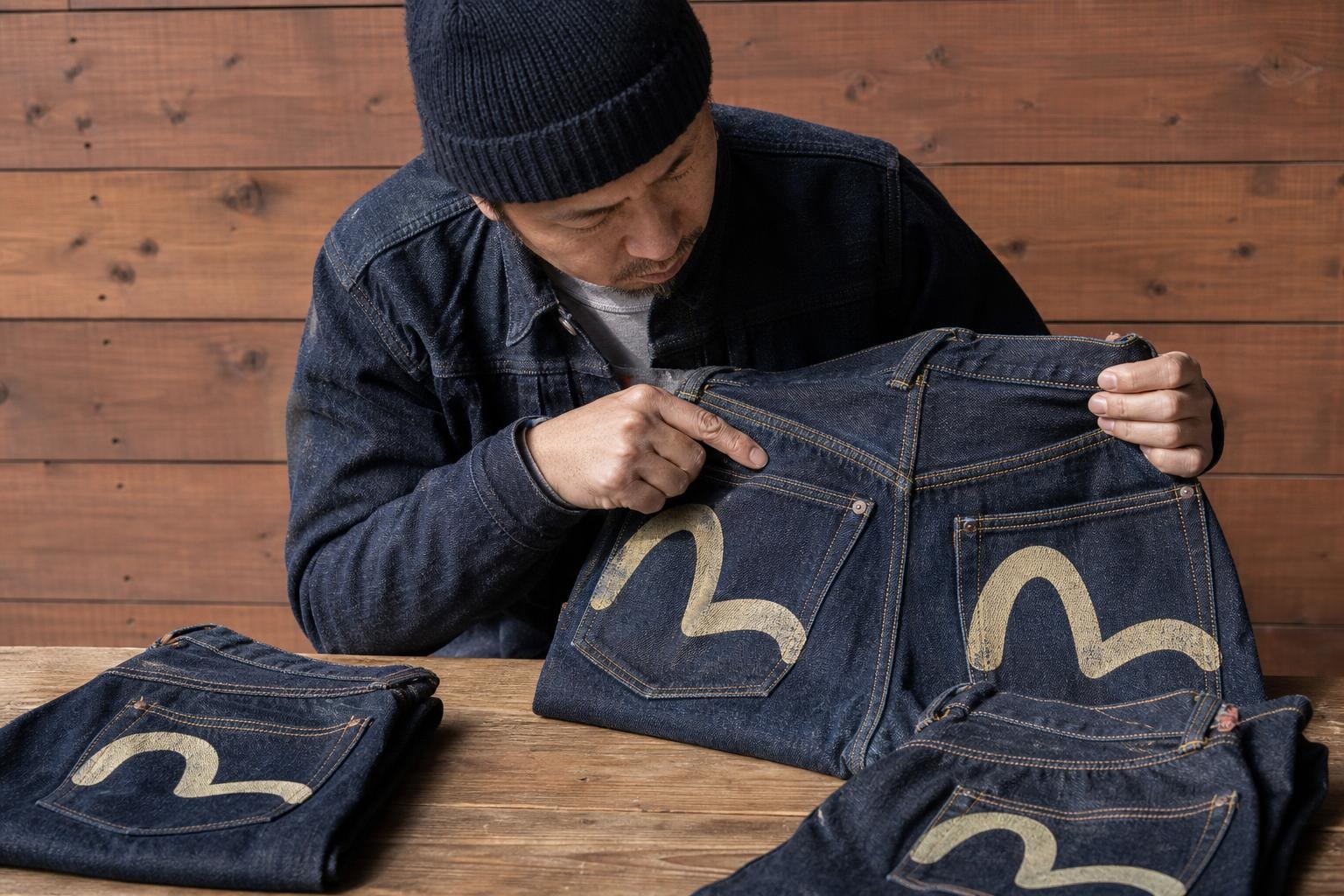
Few pieces of streetwear carry the same mystique as a pair of vintage Evisu jeans with hand-painted gull wings on the back pockets. Produced primarily in the 1990s and early 2000s in Osaka, Japan, these jeans represent a golden era of Japanese denim craftsmanship that most modern brands can only imitate. But the secondary market is flooded with fakes, reproductions, and misattributed pairs. Prices for authentic vintage Evisu gull wing painted denim jeans regularly exceed $500, and rare lots or deadstock pairs can fetch well over $1,000 in 2026. That kind of money attracts counterfeiters. Whether you’re a collector, a reseller, or just someone who found a promising pair at a thrift store, knowing exactly what to look for separates a genuine find from an expensive mistake. The details matter here: the paint texture, the selvedge quality, the hardware, the stitching, and even the care tags all tell a story. This guide breaks down every element you need to examine before spending your money. ## The Evolution of the Evisu Seagull Logo The seagull (or “kamome”) logo is the single most recognizable element of any Evisu jean. Yamane Hidehiko, who founded the brand in 1991, originally painted each pair by hand in his small Osaka workshop. Early production runs were limited to roughly 14 pairs per day because of this painstaking process. The logo itself evolved over the years, shifting in size, paint type, and application method as the brand scaled up through the late 1990s and into the 2000s. Understanding these shifts is critical for dating a pair accurately and spotting fakes that get the era wrong. ### Hand-Painted vs. Screen-Printed Designs The earliest Evisu jeans, roughly 1991 to 1999, feature genuinely hand-painted gull wings. You can identify these by looking closely at the paint surface. Hand-painted logos show slight irregularities: uneven edges, minor brush strokes visible under good lighting, and subtle thickness variations where the brush changed direction. The paint sits on top of the denim rather than soaking into the weave. Screen-printed versions, which became more common after 2000 as Evisu expanded internationally, look flatter and more uniform. The ink penetrates the fabric slightly, and the edges are crisp and identical on both pockets. Neither method is inherently “better,” but hand-painted pairs command significantly higher prices. If a seller claims a pair is hand-painted but the logo looks machine-perfect, walk away. ### Identifying Variations in Gull Wing Shape and Placement The shape of the gull wings changed across production eras. Early 1990s pairs tend to have thinner, more angular wings with a tighter spread. By the mid-to-late 1990s, the wings became broader and more stylized, sometimes filling most of the back pocket. Placement also varies: genuine vintage pairs sometimes show slight asymmetry between the left and right pocket logos, especially on hand-painted examples. This is a feature, not a flaw. Counterfeits almost always have perfectly symmetrical, identically placed logos on both pockets. That mechanical precision is actually a tell. If you’re examining a pair that claims to be from the mid-1990s, expect some human imperfection in the gull wing placement. ## Decoding the Selvedge Denim Quality Evisu built its reputation on using shuttle looms to produce selvedge denim, and the fabric quality is one of the clearest indicators of authenticity. The brand sourced its denim from traditional Japanese mills, and the resulting fabric has a texture and weight that mass-produced denim simply cannot replicate. ### Understanding No. 1, No. 2, and No. 3 Denim Grades Evisu historically categorized its denim into three tiers. No. 1 denim is the heaviest and most tightly woven, typically around 14-16 oz, produced on the oldest and slowest shuttle looms. These pairs are the most sought-after. No. 2 denim is slightly lighter, usually 12-14 oz, and was used for wider distribution. No. 3 denim, the lightest grade, appeared in more casual or fashion-forward cuts. You can often identify the grade from the leather patch or internal labeling. If neither is present, feel the fabric. No. 1 denim has a stiff, almost cardboard-like hand when unworn, and it develops dramatic fading patterns over time. If a pair claiming to be No. 1 feels soft and pliable without visible wear, something is off. ### Classic Selvedge ID Colors and Weave Characteristics Turn the cuff or open an outseam to inspect the selvedge edge. Authentic vintage Evisu pairs typically feature a red or red-and-white selvedge ID line, though some special editions used different colors. The weave should appear slightly irregular under magnification, with minor slubs and nep throughout the fabric. This irregularity is a hallmark of shuttle-loom production. Counterfeit pairs often use modern selvedge denim that looks too clean and uniform. The ID line might be the right color, but the weave itself lacks the character of vintage Japanese fabric. Compare suspect pairs against verified authentic examples if you can. ## Authenticating Hardware and Labeling Beyond the denim and paint, the hardware and labels on vintage Evisu gull wing painted denim tell their own authentication story. Fakers often get the big details right but stumble on the small ones. ### The Significance of the ‘Evis’ vs. ‘Evisu’ Red Tab This is one of the most important details for dating and authenticating a pair. Early Evisu jeans used a red tab reading “EVIS” on the right back pocket, a deliberate nod to (and slight provocation of) Levi’s. After legal pressure from Levi Strauss, the brand switched to “EVISU” on the tab. Pairs with the four-letter “EVIS” tab generally date to the early-to-mid 1990s and are among the most collectible. Check the tab’s stitching and font carefully. On authentic pairs, the lettering is clean but not laser-precise, and the tab fabric matches the quality of the surrounding denim. Reproductions frequently use tabs with slightly wrong fonts, overly bright red fabric, or sloppy attachment stitching. ### Branded Rivets, Buttons, and Hidden Reinforcements Authentic vintage Evisu jeans use branded hardware. Rivets typically bear the Evisu name or the Yamane family crest, and buttons are stamped with similar markings. The hardware should show signs of age-appropriate patina on worn pairs: a dull brass tone rather than a shiny gold finish. Look at the hidden reinforcements too. Genuine pairs often have bar tacks at stress points that use a slightly different thread color than the primary stitching. The fly buttons should feel substantial, not hollow or lightweight. Counterfeit hardware tends to feel thin and cheap, and the stamping is often shallow or blurry. ### Analyzing the Leather Godhead Patch Details The leather back patch on vintage Evisu jeans features the “Godhead” logo, a stylized figure inspired by the Buddhist deity Ebisu. On authentic pairs, this patch is made from genuine leather that ages and darkens over time. The embossing is deep and well-defined, with clean lines even on heavily worn examples. Feel the patch between your fingers. Real leather has a distinct grain and flexibility. Synthetic patches feel plasticky and don’t develop the same patina. The stitching attaching the patch should be tight and even, using a thread that matches the other topstitching on the jeans. ## Internal Construction and Care Tags Flipping the jeans inside out reveals some of the most reliable authentication markers. This is where counterfeiters cut the most corners. ### Stitching Patterns and Thread Material Vintage Evisu jeans use chain stitching on the hems and specific seams, which creates a characteristic roping effect as the denim fades. Look at the inseam and outseam construction: authentic pairs use a combination of single-needle and chain-stitch techniques. The thread is typically a cotton-poly blend in a warm gold or orange tone. Run your finger along the interior seams. On genuine pairs, the stitching is consistent but not robotic. You might find occasional slight variations in stitch density, which is normal for the era’s production methods. Fakes often use synthetic thread that looks too white or too uniform, and the stitch count per inch may be noticeably different from authentic examples. ### Reading Japanese Care Labels for Date Estimation The care tags inside vintage Evisu jeans are printed in Japanese and sometimes include English translations. These tags contain washing instructions, fabric composition, and often a lot number or production code that can help date the pair. Tags from the early 1990s tend to be simpler, with minimal information. Later tags, from the late 1990s onward, include more detailed care instructions and sizing information. The printing quality matters. Authentic tags use clear, well-aligned text on fabric that feels consistent with the era. Blurry printing, misspelled Japanese characters, or tags that feel like modern polyester are immediate red flags. If you can read Japanese or know someone who can, check the care instructions for accuracy: counterfeiters sometimes copy text incorrectly. ## Common Red Flags in Counterfeit Evisu Jeans Knowing what fakes get wrong is just as valuable as knowing what authentic pairs get right. Here are the most common tells: – Perfectly symmetrical hand-painted logos with no brush texture or variation – Selvedge denim that feels too smooth, lightweight, or uniform for the claimed grade – Hardware with shallow stamping, hollow buttons, or shiny finishes on supposedly vintage pairs – Red tabs with incorrect fonts, overly saturated color, or misaligned stitching – Care tags with blurry text, incorrect Japanese characters, or modern-feeling fabric – Leather patches made from synthetic material that doesn’t show natural aging – Chain stitching on hems that looks too perfect or uses bright white thread – Prices that seem too good: a genuine pair of early 1990s hand-painted Evisu jeans for $100 should make you very suspicious One pattern worth watching for in 2026 is the rise of “Franken-pairs,” where counterfeiters take authentic vintage denim from another brand and add fake Evisu details like painted logos and reproduction patches. These can fool casual buyers because the denim itself is genuinely old. Always examine every element together rather than relying on a single authentication point. ## Protecting Your Investment Authenticating vintage Evisu gull wing painted jeans requires patience and attention to multiple details simultaneously. No single feature confirms or denies authenticity on its own. The paint, the denim, the hardware, the labels, and the construction all need to tell a consistent story. If one element doesn’t match the era or quality of the others, dig deeper before buying. Build your eye by handling confirmed authentic pairs whenever possible, whether at vintage denim shows, reputable consignment shops, or through collector communities online. The more genuine examples you study, the faster you’ll spot fakes. And if a deal feels too good to be true, trust that instinct. The best pair of vintage Evisu jeans is one you’re confident is real.
How to Identify Vintage Evisu Gull Wing Painted Jeans
 PANTS
PANTS

コメント