Few fashion accessories carry as much subcultural weight as a vintage Hysteric Glamour mesh trucker hat. These caps, born from the collision of Japanese streetwear obsession and American pop culture nostalgia, have become some of the most sought-after archival pieces in the global resale market. What makes a simple foam-and-mesh hat worth hundreds of dollars? The answer lies in decades of countercultural design philosophy, a founder with singular vision, and a streetwear community that treats these pieces like wearable art. Understanding the full story requires going back to 1980s Tokyo, when a young designer decided to build an entire brand around his love of rock and roll, exploitation cinema, and Andy Warhol.
## The Origins of Nobuhiko Kitamura and Hysteric Glamour
### 1984 Foundations and the Harajuku Scene
Nobuhiko Kitamura launched Hysteric Glamour in 1984, a period when Harajuku was rapidly becoming the epicenter of Japanese youth fashion. The neighborhood was already home to brands like A Bathing Ape (founded a few years later) and Undercover, but Kitamura carved out a distinct lane by channeling his personal obsessions into clothing. He was fixated on American counterculture: the Rolling Stones, Blondie, B-movie posters, pin-up art, and the raw energy of 1960s and 1970s rebellion.
His first shop opened in Tokyo’s Shibuya district, and the early collections mixed denim, leather, and graphic tees with an attitude that felt more like a downtown Manhattan thrift store than a Japanese boutique. Kitamura wasn’t interested in minimalism or the clean lines dominating much of Japanese fashion at the time. He wanted grit, sex appeal, and humor, all wrapped in impeccable construction. This tension between high-quality Japanese manufacturing and deliberately trashy American imagery became the brand’s DNA.
By the late 1980s, Hysteric Glamour had developed a loyal following among musicians, artists, and fashion insiders in Tokyo. The brand’s accessories, including trucker-style hats, started appearing as natural extensions of the graphic-heavy clothing lines.
### Pop Art and 1960s Mass Media Influences
Kitamura’s design language drew heavily from Pop Art’s playbook. Andy Warhol’s repetition of commercial imagery, Roy Lichtenstein’s comic-book aesthetics, and the general attitude that “low” culture was just as valid as “high” culture all filtered directly into Hysteric Glamour’s output. The brand treated advertising slogans, pin-up illustrations, and rock iconography as raw material to be remixed and recontextualized.
This approach gave the trucker hats their distinctive character. Rather than slapping a simple logo on the front panel, Kitamura and his design team created miniature graphic compositions. A single hat might feature a distorted pin-up girl, a psychedelic font treatment, or a provocative slogan that referenced 1960s counterculture. The designs felt like they belonged on a concert poster or a vintage magazine cover, not on a piece of headwear.
This Pop Art sensibility also meant the hats never felt purely nostalgic. They were commentary on nostalgia itself: a Japanese designer filtering American cultural artifacts through his own lens, creating something that belonged to neither culture entirely.
## Design Anatomy of the Classic Mesh Trucker Hat
### Signature Graphics and Provocative Typography
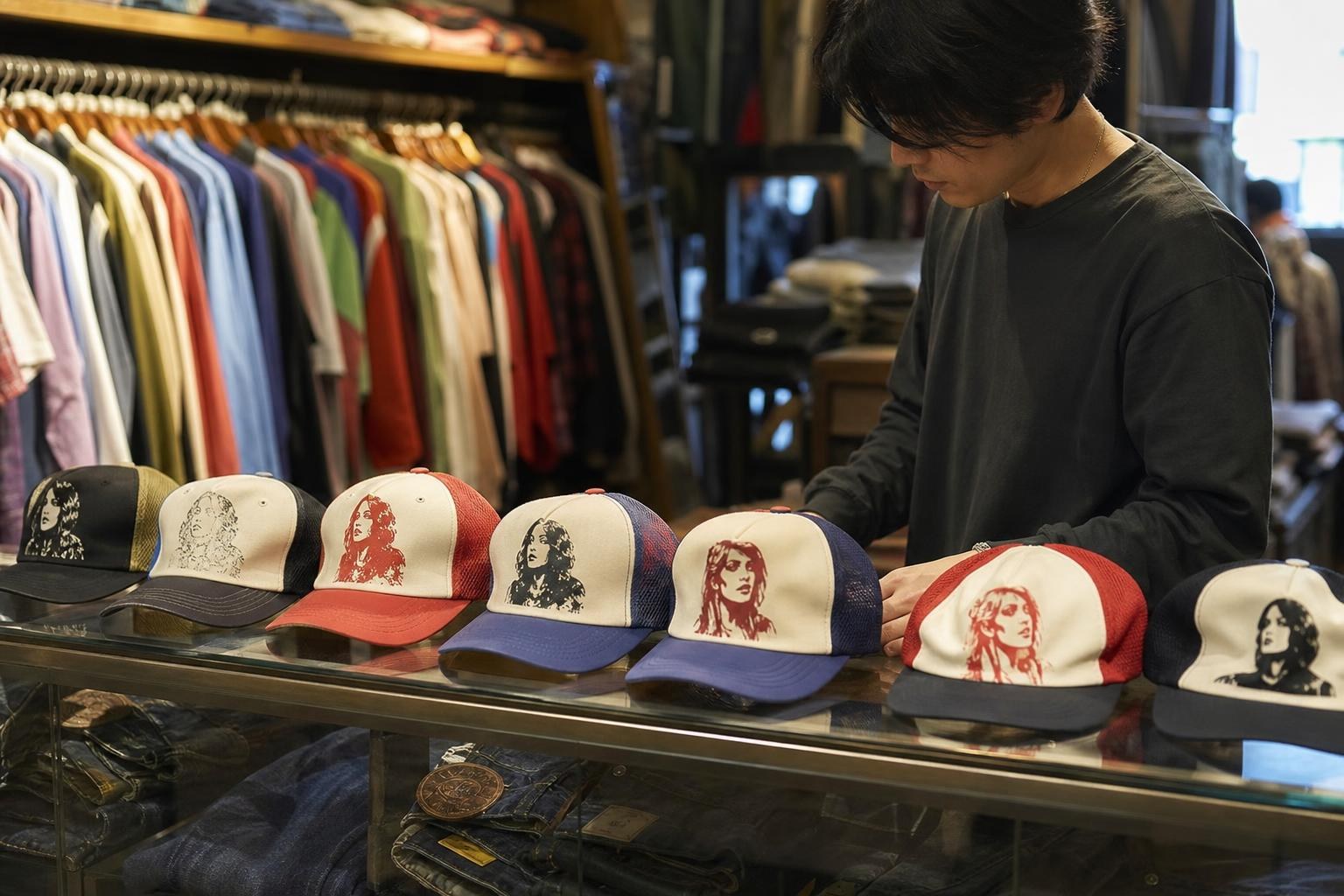
The front panels of Hysteric Glamour trucker hats function as small canvases. Across various seasons and collaborations, several recurring graphic motifs have defined the brand’s hat output. Pin-up girls rendered in a style somewhere between Vargas illustrations and underground comix appear frequently, often accompanied by the brand name in custom lettering. The “Hysteric Glamour” wordmark itself has appeared in dozens of typographic treatments: sometimes in a clean serif font, sometimes in dripping psychedelic letters, sometimes hand-drawn to look like a ransom note.
Specific hat designs have become grails in the collector community. The “Guitar Girl” graphic, featuring a woman straddling an electric guitar, is one of the most recognizable. Skull motifs, flames, and references to specific bands or films appear across different production years. Some hats carry explicit imagery that would be difficult to produce for a mainstream Western brand, reflecting Japan’s different cultural boundaries around provocative fashion.
The typography is often bilingual, mixing English phrases with Japanese text, which adds another layer of visual complexity and cultural crossover appeal.
### Material Construction and the ‘Kitsch’ Aesthetic
A Hysteric Glamour trucker hat follows the classic American trucker cap template: a structured foam front panel, a plastic snapback closure, and mesh rear panels for ventilation. The brand didn’t reinvent the form. Instead, it elevated the materials and printing quality while keeping the deliberately cheap-looking silhouette intact.
The foam panels on authentic vintage pieces tend to be slightly stiffer than typical promotional truckers, and the screen printing or embroidery shows a level of detail that mass-produced caps simply don’t achieve. Some designs incorporate puff printing, metallic inks, or multi-color layering that required more production steps than a standard hat run.
This is the core of the kitsch aesthetic Kitamura pursued: taking a form associated with gas stations and feed stores, then applying fine-art-level graphic design to it. The result is an object that’s simultaneously low-brow and highly considered, cheap-looking and expensive to produce. That contradiction is exactly what makes these hats compelling to collectors.
## Cultural Impact and the 2000s Streetwear Boom
### The Ura-Harajuku Movement and Global Crossover
The late 1990s and early 2000s saw the rise of what insiders called “Ura-Harajuku,” meaning “back Harajuku,” a network of small shops and brands operating in the backstreets behind the main Harajuku thoroughfare. Hysteric Glamour was a key player in this scene alongside NEIGHBORHOOD, WTAPS, and Visvim. These brands shared a reverence for American workwear and military surplus but filtered it through Japanese craftsmanship and graphic sensibility.
Trucker hats became one of the most visible symbols of this movement. While the rest of the world was still treating trucker caps as ironic accessories (thanks largely to Ashton Kutcher’s mid-2000s trucker hat trend), Japanese streetwear brands had been producing collectible versions for years. Hysteric Glamour’s mesh caps circulated through stores like Union and Nowhere in Tokyo, eventually making their way to Western buyers through early online forums and proxy shopping services.
The global crossover accelerated as streetwear blogs and forums like Superfuture and Hypebeast began documenting Japanese brands for English-speaking audiences. Suddenly, a Hysteric Glamour trucker hat wasn’t just a Tokyo insider piece: it was an internationally recognized status symbol.
### Celebrity Endorsement and the It-Item Status
Celebrity co-signs pushed these hats further into mainstream consciousness. Musicians like Pharrell Williams and members of the Japanese hip-hop scene were photographed wearing Hysteric Glamour regularly throughout the 2000s. The brand’s relationship with rock culture meant that guitarists and vocalists from both Western and Japanese bands gravitated toward the provocative graphics.
What separated Hysteric Glamour from other celebrity-worn brands was that the endorsement felt organic. Kitamura wasn’t paying for placements or sending PR packages to stylists. Musicians found the brand because it spoke their language: loud, irreverent, and rooted in the same rock-and-roll mythology they lived inside. This authenticity gave the vintage pieces even more credibility in the resale market, because the cultural connection was genuine rather than manufactured.
## The Modern Resurgence in Vintage Markets
### Navigating the Archival Fashion Community
The archival fashion market in 2026 has matured significantly, and Hysteric Glamour mesh trucker hats occupy a specific tier within it. Platforms like Grailed, Yahoo! Japan Auctions, and specialized Instagram sellers are the primary channels where these pieces change hands. Prices vary wildly depending on the specific graphic, production year, and condition, but expect to pay anywhere from $80 for a common design to $400 or more for a rare collaboration or early-1990s piece.
The community around archival Japanese streetwear is knowledgeable and opinionated. Collectors often specialize in specific eras or graphic themes, and provenance matters. A hat with a verifiable history, perhaps purchased from a specific Tokyo shop or part of a known collection, commands a premium. Online communities on Discord and Reddit dedicated to Japanese archive fashion serve as both marketplaces and authentication resources.
Timing your purchases matters too. Prices tend to spike when a particular brand gets a burst of social media attention, so buying during quieter periods can save you significant money.
### Identifying Authentic Vintage vs. Modern Reissues
Hysteric Glamour still produces trucker hats in 2026, which means distinguishing between a genuinely vintage piece and a modern reissue requires some knowledge. Here are the key markers to look for:
– Older pieces typically feature “Made in Japan” tags with specific font treatments and tag materials that changed across production eras
– Vintage snap closures tend to be simpler plastic snaps, while newer versions sometimes use branded hardware
– Screen printing on 1990s and early 2000s hats often shows slight imperfections and ink layering that differs from modern digital printing methods
– Fading and patina on the mesh panels should be consistent with age: artificially distressed pieces have a uniform wear pattern that looks unnatural
– Care tags evolved over the decades, and cross-referencing tag styles with known production dates is one of the most reliable authentication methods
Fakes do exist, particularly for the most popular graphics. If a deal seems too good, it probably is. Buying from established sellers with transaction histories and community reputations remains the safest approach.
## Styling the Hysteric Glamour Aesthetic Today
Wearing a vintage Hysteric Glamour cap in 2026 works best when you treat it as the focal point rather than an afterthought. The graphics are bold enough to anchor an entire outfit, so the rest of your clothing should either complement the hat’s energy or provide a deliberate contrast.
The most natural pairing is with other Japanese streetwear or Americana-influenced pieces: a well-worn pair of selvedge denim, a vintage band tee, and boots or chunky sneakers. This keeps you within the cultural universe the hat was designed for. Alternatively, wearing the hat with cleaner, more contemporary pieces like tailored trousers and a simple knit creates tension between the hat’s trashy glamour and the rest of the outfit’s restraint. That tension mirrors the same high-low dynamic Kitamura built into the brand itself.
Avoid over-coordinating. Stacking multiple Hysteric Glamour pieces head to toe can look like a costume rather than an outfit. Let the hat do the talking, and keep everything else relatively quiet. The cap already carries decades of design history, subcultural credibility, and visual impact: it doesn’t need help.
If you’re just starting to explore archival Japanese streetwear, a Hysteric Glamour trucker cap is one of the best entry points. It’s more affordable than vintage jackets or denim, it’s instantly recognizable to people who know, and it connects you to a design legacy that stretches back over four decades. Start with a graphic that genuinely speaks to you rather than chasing whatever’s trending on resale platforms. The best pieces in any collection are the ones you actually want to wear.


コメント