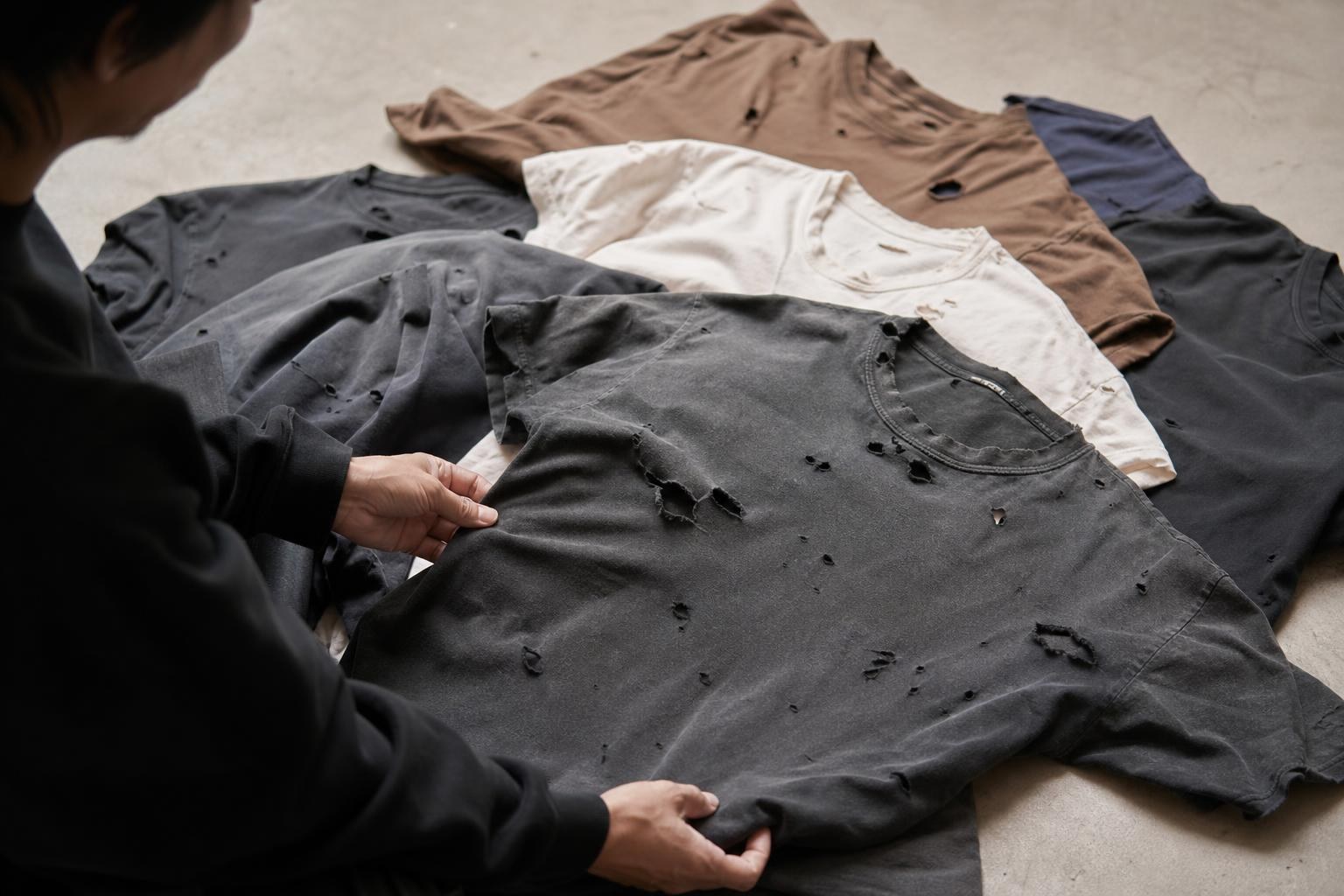
Few brands in Japanese fashion history carry the same weight as Number (N)ine. Founded by Takahiro Miyashita in 1997 and shuttered in 2009, the label left behind a body of work that continues to shape how designers think about the intersection of music, emotion, and clothing. The distressed t-shirts from Number (N)ine’s archive remain some of the most sought-after pieces in the vintage fashion market, commanding prices that rival fine art prints. These weren’t just garments with holes punched through them. Each piece carried a specific emotional charge, a reference to a song or a film or a feeling that Miyashita wanted to preserve in cotton and thread. For collectors and enthusiasts trying to understand the Number Nine distressed t-shirt archive, the rabbit hole runs deep: spanning over a decade of seasonal collections, each with its own visual language and thematic obsessions. Whether you’re a longtime collector or just starting to notice these pieces appearing on resale platforms at staggering prices, understanding the context behind them changes everything. This guide breaks down the techniques, the iconic collections, and the practical knowledge you need to identify authentic pieces. ## The Origins of Takahiro Miyashita’s Design Philosophy Takahiro Miyashita wasn’t trained at a prestigious fashion school. He came up through the Harajuku scene of the early 1990s, absorbing the raw energy of punk, grunge, and classic rock culture that permeated Tokyo’s youth subcultures. His design instincts were shaped less by pattern-making textbooks and more by album covers, concert footage, and the lived-in quality of clothing worn by musicians he idolized. This background gave Number (N)ine an authenticity that separated it from brands merely borrowing rock aesthetics for commercial appeal. ### Musical Influence and the Rock Aesthetic Miyashita’s collections read like mixtapes. Each season drew from a specific musical universe: Kurt Cobain’s fragile aggression, the Clash’s political fury, Iggy Pop’s nihilistic swagger. The distressed t-shirts from these collections weren’t generic “worn-in” pieces. A shirt referencing Nirvana’s In Utero era would carry a different quality of destruction than one inspired by the Ramones. The holes were placed with intention, the fading calibrated to evoke a specific era of live music. Miyashita reportedly studied photographs of musicians’ actual wardrobes to understand how real wear patterns formed on stage, then replicated those patterns through deliberate hand-finishing processes in his Tokyo atelier. ### The Concept of ‘The Soloist’ and Individualism Before Miyashita launched his post-Number (N)ine project (literally called “The Soloist”), the concept of the solitary creative figure already ran through his work. His t-shirts were designed for individuals, not crowds. Many pieces were produced in extremely limited quantities, sometimes fewer than 50 units. The distressing on each shirt varied slightly because much of it was done by hand, meaning no two pieces were truly identical. This philosophy of irreproducibility is part of what makes the archive so compelling to collectors in 2026: you can’t just reissue these pieces and capture the same effect. The imperfection was the point. ## Signature Distressing Techniques and Materials What set Number (N)ine apart from other brands experimenting with destroyed aesthetics was the sophistication of the process. This wasn’t someone attacking a shirt with scissors. Miyashita and his team developed layered techniques that gave each piece a sense of history, as if the garment had lived through something before reaching the wearer. ### The Art of Bullet Holes and Fraying The “bullet hole” effect became one of the brand’s most recognizable signatures, particularly in the AW04 “Give Peace a Chance” collection. These weren’t simple punched holes. The edges were carefully frayed and heat-treated to prevent unraveling while maintaining a raw, organic look. Some pieces featured dozens of these perforations across the body and sleeves, creating a visual effect that was simultaneously violent and beautiful. The fraying technique involved pulling individual threads from the cotton jersey at specific stress points, then locking the distress in place through washing and pressing. Collectors can often identify the season of a piece by examining how the fraying was executed: earlier collections tend to show more conservative distressing, while later seasons pushed the destruction further. ### Sun-Bleaching and Vintage Wash Processes Beyond physical destruction, Miyashita employed chemical and environmental processes to age his fabrics. Sun-bleaching was used on select pieces to create uneven fading that mimicked years of wear. The brand also developed proprietary wash processes that softened the cotton to a near-tissue weight, giving the shirts a drape that felt decades old despite being newly manufactured. Some pieces went through multiple wash cycles with enzyme treatments that broke down the fibers just enough to create that perfect “been through a hundred wash cycles” texture. The color palette of these treated shirts ranged from deep, bruised blacks to washed-out grays and ghostly whites, each shade precisely controlled despite the organic nature of the process. ## Iconic Collections and Graphic Motifs Number (N)ine’s seasonal collections each had a distinct personality, and the graphic t-shirts served as the most accessible entry point into each season’s world. Understanding which graphics belong to which collection is essential for anyone studying the archive seriously. ### The ‘Gotham City’ and ‘Dream Baby Dream’ Eras The SS06 “Dream Baby Dream” collection, named after the Suicide song, produced some of the most emotionally charged t-shirts in the brand’s history. Soft, washed-out graphics of roses, skulls, and handwritten text appeared on ultra-thin cotton, creating pieces that felt like love letters written on skin. The AW05 collection, often referred to as “The High Streets” or informally as the “Gotham City” season, took a darker turn with heavily distressed pieces featuring cityscape imagery and references to urban decay. These two collections represent the emotional poles of Miyashita’s work: tenderness and destruction, often existing in the same garment. Pieces from both seasons regularly sell for $1,000 to $5,000 on the secondary market, with exceptional examples pushing even higher. ### Collaborative Graphics and Band Parodies One of the most distinctive elements of the Number Nine distressed t-shirt archive is the way Miyashita played with existing band imagery. Rather than simply reproducing concert merch, he reimagined iconic album art and logos through his own lens. The Guns N’ Roses skull was redrawn. The Rolling Stones tongue was reinterpreted. These weren’t licensed collaborations: they were artistic commentary on the relationship between music merchandise and fashion. Some pieces featured entirely original graphics that parodied or paid homage to specific bands without directly copying them, walking a fine line that added to their mystique. The AW03 “Touch Me I’m Sick” collection (referencing Mudhoney) and the AW04 collection both featured particularly strong graphic work that has become iconic within the archive. ## Identifying Authentic Number (N)ine Archive Pieces With prices climbing steadily throughout the 2020s, the market for fake Number (N)ine pieces has grown proportionally. Knowing how to authenticate a piece before spending serious money is non-negotiable for collectors. ### Evolution of Neck Tags and Care Labels Number (N)ine’s labeling changed several times across its 12-year run, and these changes serve as one of the most reliable authentication tools: – Early pieces (1997-2000) used a simple black-on-white woven tag with “NUMBER (N)INE” in a clean typeface – Mid-period pieces (2001-2005) transitioned to a more refined tag with the brand name and a seasonal code printed on the care label – Late-period pieces (2006-2009) featured updated typography and sometimes included “TAKAHIRO MIYASHITA” on the tag The care labels contain crucial information: a three-digit code that corresponds to the collection season. Cross-referencing this code with known collection databases (several are maintained by dedicated collector communities online) can confirm whether a piece is genuine and which season it belongs to. Fakes often get the font spacing wrong on these labels, or use incorrect seasonal codes. ### Distinguishing Between OG and Modern Reprints Since Miyashita’s departure, there have been various reissue projects under different entities. These reprints are legitimate products, but they carry a fraction of the value of original archive pieces. The key differences lie in the construction details: original pieces were made in Japan using specific cotton jerseys that have a particular hand-feel, while reprints often use different base fabrics. The distressing on originals shows the kind of irregularity that comes from hand-finishing, whereas reprints tend to have more uniform destruction patterns. Stitching quality, dye saturation, and even the weight of the fabric all differ. If you’re spending four figures on a piece, handling it in person (or buying from a reputable dealer who provides detailed photographs) is the safest approach. ## The Lasting Impact on Modern Luxury Streetwear The influence of Number (N)ine’s distressed archive on contemporary fashion is hard to overstate. Brands like Undercover, Celine under Hedi Slimane, and a generation of independent labels have drawn directly from Miyashita’s playbook. The idea that a t-shirt could be a serious design object, that destruction could be a form of craftsmanship, and that music fandom could translate into high fashion: these concepts feel obvious now, but they weren’t before Miyashita proved them. In 2026, archive Number (N)ine pieces occupy a unique position in the market. They’re too culturally significant to be dismissed as vintage curiosities, yet too rare to be treated as commodities. Each piece in the distressed t-shirt archive tells a specific story about a moment in Miyashita’s creative life, a song he couldn’t stop listening to, a film that haunted him, a texture he wanted to feel against skin. That emotional specificity is what keeps collectors coming back and what makes these shirts worth studying beyond their market value. If you’re building a collection or simply trying to understand why a torn-up t-shirt can sell for the price of a used car, start with the collections mentioned here and work outward. The archive rewards patience and genuine curiosity.
A Guide to the Number (N)ine Distressed T-Shirt Archive
 SHIRTS

コメント