
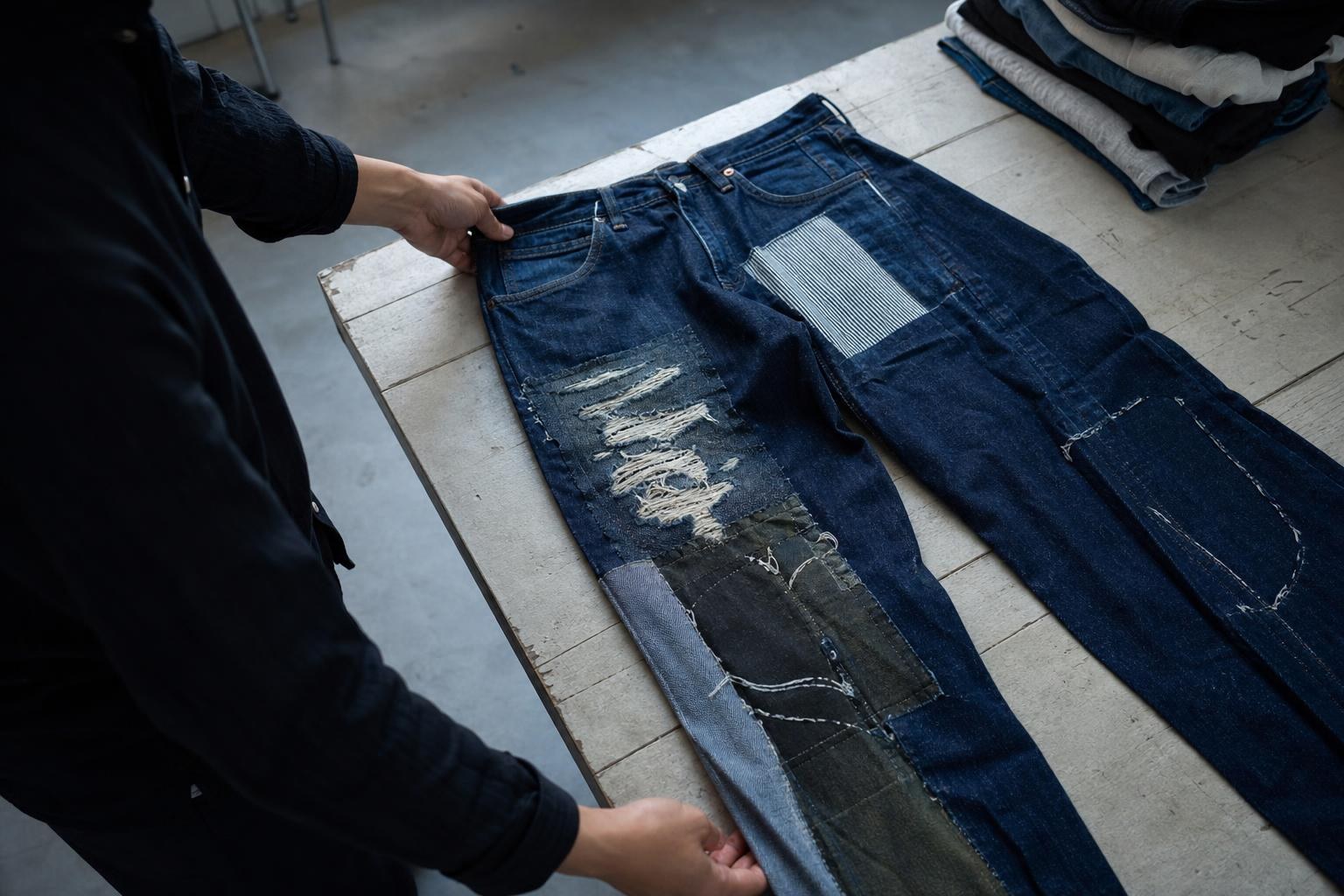
Few garments in the history of Japanese fashion carry the mythic weight of the Undercover scab denim jeans from the 2003 archive. These pieces, born from Jun Takahashi’s restless creative mind, represent a collision of punk ideology, haute couture ambition, and raw artistic expression that the fashion world had never quite seen before. More than two decades later, they remain some of the most coveted and discussed garments in the archive fashion community, fetching prices that would make most luxury houses blush. What makes a pair of jeans worth thousands of dollars? The answer lives in the story behind them: a story about rebellion, obsession, and the moment a Tokyo underground designer decided to burn down every convention the fashion establishment held dear. ## The Genesis of the SCAB Collection and Jun Takahashi’s Vision The SCAB collection, shown for Undercover’s Spring/Summer 2003 season, arrived at a pivotal moment in Jun Takahashi’s career. He had spent the better part of a decade building Undercover from a small Harajuku operation into something that demanded international attention. But SCAB wasn’t just another seasonal offering. It was a thesis statement, a distillation of everything Takahashi believed clothing could communicate about pain, beauty, and the human body’s fragility. The collection’s name itself evokes wound healing: the protective crust that forms over damaged skin. Takahashi drew from imagery of scarring, medical bandaging, and bodily trauma, translating these concepts into garments that looked simultaneously destroyed and meticulously constructed. The denim pieces, in particular, became the collection’s most enduring icons. ### Undercover’s Transition to the Paris Runway Takahashi had shown in Tokyo for years, but the early 2000s marked his deliberate push toward the Paris fashion calendar. His 2002 debut on the Paris runway made waves, but SCAB was the collection that cemented his reputation among European critics and buyers. Showing in Paris meant competing directly with the established French and Italian houses, and Takahashi responded not by conforming but by doubling down on his outsider identity. The SCAB show featured models in states of beautiful disarray, their denim patched and layered in ways that read as both couture and anti-couture simultaneously. Paris took notice because Takahashi wasn’t trying to be European. He was offering something genuinely different. ### Seditions of the Post-Punk and Crust Punk Aesthetic Takahashi’s relationship with punk has always been complicated. He wasn’t mimicking the Sex Pistols or copying Vivienne Westwood’s playbook. His references ran deeper, pulling from the crust punk and post-punk scenes that thrived in the underground throughout the 1980s and 1990s. Crust punk, with its deliberately filthy aesthetic, DIY patches, and anti-capitalist ethos, provided a visual vocabulary that Takahashi reinterpreted through a Japanese lens. The SCAB denim pieces reflected this influence through their layered patches, distressed surfaces, and a general sense that the garments had lived hard lives before ever reaching a customer. But where actual crust punk clothing was assembled from necessity and poverty, Takahashi’s versions were painstakingly crafted to achieve that appearance: a paradox he seemed to relish. ## Anatomy of the 2003 Scab Archive Denim Understanding why these jeans command such reverence requires looking closely at their physical construction. Each pair is essentially a wearable collage, combining multiple denim washes, fabric types, and handwork techniques into a single garment. The base construction uses high-quality Japanese selvedge denim, but that’s only the starting point. From there, the jeans were subjected to an elaborate process of deconstruction and reconstruction that blurred the line between fashion design and textile art. ### Hand-Stitched Ethnic Embroidery and Patchwork Techniques The most distinctive feature of the SCAB denim is the embroidery work. Takahashi incorporated motifs drawn from various global textile traditions: South Asian mirror work, Central American cross-stitch patterns, and Japanese sashiko stitching all appear across different pieces in the collection. These weren’t machine-applied decorations. Artisans hand-stitched each element, meaning no two pairs are truly identical. The patchwork follows a similar philosophy. Panels of contrasting denim, sometimes raw indigo against faded light wash, were cut and reassembled in configurations that suggest repair and reinforcement. Some patches sit flat against the base fabric; others are deliberately left with raw, fraying edges. The effect is of a garment that has been loved, torn, and mended repeatedly over years, though in reality each detail was planned and executed with precision. ### The Significance of the Crust-Inspired Multi-Layering Layering on the SCAB denim goes beyond simple patchwork. Some pairs feature fabric panels that hang loosely, creating dimensional texture. Others incorporate strips of different materials: canvas, twill, even what appears to be repurposed military fabric. This multi-layering directly references the crust punk tradition of sewing patches, studs, and fabric scraps onto clothing until the original garment is barely visible beneath the additions. Takahashi’s genius was in controlling this chaos. Where actual punk layering is spontaneous and personal, his version maintained a compositional balance. The placement of each patch, each embroidered section, follows an internal logic that becomes apparent when you study the garments closely. There’s rhythm to the arrangement, a visual cadence that separates intentional design from random accumulation. ## Production Complexity and the DIY Ethos The contradiction at the heart of the SCAB collection is that its DIY appearance required extraordinary manufacturing sophistication. Takahashi was essentially asking his production team to industrialize the handmade, to create consistency within a framework of apparent randomness. ### Labor-Intensive Manufacturing and Limited Quantities Each pair of SCAB denim required hours of hand labor that made mass production impossible. The embroidery alone could take a single artisan an entire day per pair. When you factor in the cutting, patching, distressing, washing, and finishing processes, production numbers stayed extremely low. Exact figures are difficult to confirm, but industry estimates suggest certain SCAB denim styles were produced in quantities of fewer than a hundred pairs. This scarcity wasn’t primarily a marketing strategy. It was a practical consequence of the production methods. Undercover was still a relatively small operation in 2003, and the brand’s workshops simply couldn’t produce these labor-intensive pieces at scale. The result is that authentic SCAB denim exists in genuinely limited numbers, which has only intensified collector demand over the past two decades. ## Cultural Impact and the Rise of Archive Fashion The SCAB collection didn’t just influence other designers. It helped create an entire category of fashion consumption: the archive market. ### Influence on Modern Streetwear and Luxury Design Traces of Takahashi’s SCAB-era work appear throughout contemporary fashion. Brands ranging from Kapital to Amiri have explored similar territory with distressed, patchwork denim, though few achieve the same level of conceptual depth. Even major luxury houses have incorporated elements of the punk-meets-craft aesthetic that Takahashi pioneered. When you see a $2,000 pair of pre-distressed jeans from a European fashion house, you’re looking at a downstream effect of what Undercover was doing in 2003. The collection also influenced how designers think about denim as a medium. Before SCAB, high-fashion denim was largely about fit and wash. Takahashi demonstrated that jeans could carry the same artistic weight as any other garment category, and that message has resonated through two decades of design. ### The Scab Denim as a Grailed Status Symbol On resale platforms like Grailed, authentic 2003 Undercover scab denim has become a benchmark of collector credibility. Prices for original pairs regularly exceed $3,000 and can climb significantly higher for rare variations or pieces in exceptional condition. Owning a pair signals deep knowledge of fashion history and a willingness to invest in garments with genuine cultural significance. The Grailed community has been instrumental in documenting and authenticating these pieces. Detailed forum posts and listing descriptions have created an informal archive of information about the collection, cataloging different styles, colorways, and construction details. This community-driven scholarship has actually increased demand by making the pieces more accessible to a broader audience of collectors who might not have encountered them otherwise. ## Identifying and Collecting Authentic Scab Denim For anyone considering acquiring a pair, authentication is critical. The high prices these pieces command have inevitably attracted reproductions and outright fakes. ### Key Distinctions Between Original 2003 and Re-issue Versions Undercover has periodically revisited SCAB-era motifs in later collections, and these re-issues are sometimes confused with or misrepresented as original 2003 pieces. Several details help distinguish them: – Original 2003 pieces carry specific interior tags with the collection season clearly marked, using a tag format Undercover discontinued in later years – The denim weight and weave on originals tends to be heavier than re-issue versions, reflecting the specific mill runs used for the original production – Hand-stitching on authentic 2003 pairs shows slight irregularities consistent with artisan work, while later versions sometimes incorporate machine embroidery – Hardware, including rivets and buttons, on original pairs uses specific finishes that differ from subsequent Undercover production runs Consulting with established sellers who specialize in Japanese archive fashion is the safest approach. Community resources on platforms like Grailed and dedicated forums provide comparison photos and detailed guides that can help verify authenticity before committing to a purchase. ## The Lasting Legacy of Jun Takahashi’s Masterpiece More than twenty years after the SCAB collection debuted on the Paris runway, its denim pieces continue to shape conversations about what fashion can be. They represent a moment when a designer from Tokyo’s underground proved that clothing could be simultaneously raw and refined, punk and precious, deeply personal and universally resonant. The Undercover 2003 archive denim from the SCAB collection isn’t just a collector’s trophy. It’s a document of creative ambition at its most uncompromising. Takahashi didn’t design these jeans to be safe investments or status symbols. He made them because he had something to say about beauty, damage, and the human impulse to repair what’s broken. For collectors, designers, and anyone who believes clothing can carry meaning beyond brand logos and seasonal trends, these pieces remain essential reference points. They remind us that the most enduring fashion doesn’t follow rules. It writes new ones.
The History of Undercover 2003 Scab Archive Denim Jeans
 PANTS
PANTS

コメント