Few Japanese fashion labels have built the kind of cult mythology that Hysteric Glamour carries. Founded in 1984, the brand has spent four decades weaving together punk, rock ‘n’ roll, and counterculture imagery into garments that feel more like wearable art than simple clothing. Among its most sought-after pieces, vintage Hysteric Glamour snake loop print denim stands in a category of its own: a design that merges rebellious energy with meticulous Japanese craftsmanship. These pieces aren’t just jeans or jackets. They’re artifacts from a specific moment in Tokyo’s fashion underground, and they command serious attention from collectors worldwide. Whether you’ve been hunting for a pair for years or just stumbled across the motif on a resale platform, understanding the history, construction, and market dynamics behind this print will help you make smarter decisions and appreciate what you’re actually looking at.
## Origins and Legacy of the Snake Loop Motif
### Nobuhiko Kitamura and the 1960s Influence
Hysteric Glamour founder Nobuhiko Kitamura has never hidden his obsessions. His designs pull from 1960s and 1970s Americana: biker culture, psychedelia, pin-up art, and the raw visual language of rock music. The snake motif fits squarely into that world. Serpents have been symbols of rebellion, danger, and transformation across Western counterculture for decades, showing up on everything from Harley-Davidson tanks to Guns N’ Roses album covers.
Kitamura’s genius was taking that imagery and filtering it through a distinctly Japanese lens. The snake loop print isn’t a simple graphic slapped onto fabric. It’s a repeating, interlocking pattern that treats the serpent as a textile element rather than an illustration. That approach reflects Kitamura’s training in fashion design and his respect for garment construction. He wanted the print to feel integrated into the denim itself, not like an afterthought. The result is something that reads as both Western rock culture and Japanese artisanal craft simultaneously.
### The Rise of the Snake Print in Ura-Harajuku Culture
The snake loop print gained its strongest foothold during the late 1990s and early 2000s, right as the Ura-Harajuku movement was reshaping how the world thought about Japanese street fashion. Brands like A Bathing Ape, Undercover, and Hysteric Glamour operated out of backstreet shops in Harajuku, building fanatical followings through limited production runs and word-of-mouth hype.
Hysteric Glamour’s snake print denim became a staple among the Tokyo crowd that mixed punk aesthetics with high-end Japanese denim quality. These weren’t mass-produced items. Production numbers were intentionally small, and certain colorways or cuts appeared for a single season before disappearing entirely. That scarcity, combined with the brand’s refusal to chase mainstream trends, cemented the snake loop as a collector’s grail. By the mid-2000s, pieces from this era were already trading at premiums on Japanese auction sites and vintage shops in Shimokitazawa.
## Design Characteristics and Iconic Variations
### The Anatomy of the Repeating Snake Pattern
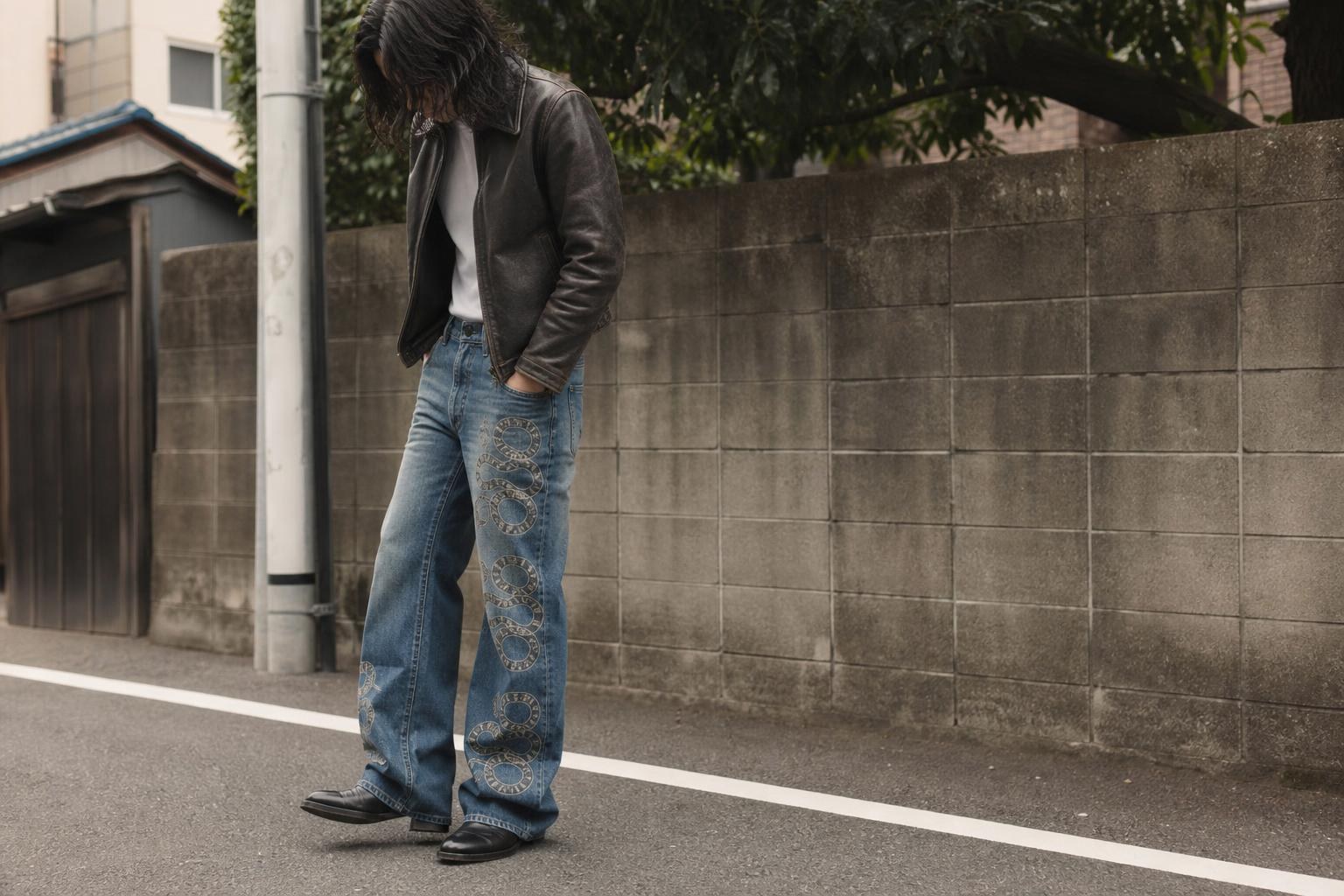
What makes the snake loop print distinctive is its construction as a true repeating pattern. Unlike a one-off graphic print on a back pocket or leg panel, the snake loop covers entire sections of the garment in an interlocking, tessellated design. Each serpent curves into the next, creating a visual rhythm that moves with the fabric.
The snakes themselves are rendered with enough detail to feel illustrative: scales, forked tongues, coiled bodies: but they’re stylized enough to function as a pattern rather than a picture. On most authentic pieces, the print is applied via screen printing directly onto the denim, which means it interacts with the fabric’s texture. As the denim fades and wears over time, the print develops its own patina, creating a lived-in quality that printed cotton or synthetic fabrics simply can’t replicate.
### Colorways: From Classic Indigo to High-Contrast Palettes
The most recognizable versions feature the snake loop printed in contrasting tones over raw or lightly washed indigo denim. White or cream ink on dark indigo is probably the most iconic combination, and it’s the one that shows up most frequently in collector circles. But Hysteric Glamour released the motif across a surprising range of palettes over the years.
Some seasonal releases used black-on-black printing, where the snake pattern is only visible in certain lighting or at specific angles. Others went bold with red, gold, or even metallic inks. A few rare pieces reversed the formula entirely, printing dark snakes onto bleached or heavily distressed denim. Each colorway carries different value on the secondary market, with the black-on-black and metallic variants generally commanding the highest prices due to their extremely limited production numbers.
## Authentication and Quality Indicators
### Analyzing Tags, Labels, and Hardware
Fakes exist, and they’ve gotten more convincing in recent years. Knowing what to look for on authentic Hysteric Glamour snake print denim can save you hundreds of dollars and a lot of frustration.
Start with the interior tags. Genuine pieces feature a main brand label that’s cleanly stitched with consistent font spacing. The “Hysteric Glamour” text should be crisp, not blurry or unevenly printed. Look for a care label with Japanese text: the washing instructions and fabric composition should be printed in Japanese, sometimes with English translations. Country-of-origin tags on authentic vintage pieces will almost always read “Made in Japan.”
– Buttons and rivets should carry branded markings, often with “HG” or the full brand name stamped into the metal
– Zipper pulls on genuine pieces are typically YKK, which was the standard hardware supplier for Japanese denim brands during this era
– Stitching should be tight and even, with no loose threads or irregular spacing along seams
### Denim Weight and Screen-Printing Texture
The denim itself tells a story. Authentic Hysteric Glamour pieces from the late 1990s through mid-2000s typically use mid-weight Japanese selvedge denim, usually in the 12 to 14 oz range. The fabric should feel substantial without being stiff, and well-worn examples will show the kind of natural fading patterns: whiskers, honeycombs, and stack marks: that only develop through genuine wear on quality denim.
Run your fingers over the snake print. On authentic pieces, screen-printed ink sits slightly raised on the fabric surface. You should be able to feel a subtle texture difference between printed and unprinted areas. Counterfeit versions often use heat-transfer or digital printing methods that sit flat against the fabric and lack that tactile quality. On heavily worn originals, the print will show natural cracking and fading that follows the garment’s wear patterns, which is nearly impossible to replicate artificially.
## Styling the Hysteric Glamour Aesthetic
### Pairing with Punk and Rock-Infused Essentials
The snake loop print carries a lot of visual weight, so the rest of your outfit needs to either complement that energy or deliberately contrast it. The most natural pairings lean into the punk and rock roots that inspired the design in the first place.
A worn-in band tee: think Ramones, Motörhead, or any of the acts Kitamura himself references: works perfectly with snake print jeans. Leather jackets, particularly classic double-rider styles, match the rebellious tone without competing for attention. Footwear should stay grounded: engineer boots, Converse Chuck Taylors, or creeper shoes all fit the aesthetic. The key is keeping everything else relatively simple so the denim remains the focal point.
### Modern Streetwear vs. Period-Correct Outfits
There are two schools of thought on styling these pieces in 2026. The first approach is period-correct: dressing as if you pulled the entire outfit from a 2001 Ura-Harajuku lookbook. That means mixing the snake print denim with other Japanese streetwear brands from the same era, vintage rock merchandise, and chunky silver jewelry.
The second approach treats the denim as a statement piece within a contemporary wardrobe. Pairing snake loop jeans with a clean oversized hoodie, minimalist sneakers, and a simple cap creates a tension between the loud print and restrained styling that reads as intentional rather than costume-like. Neither approach is wrong. The period-correct route appeals to purists and collectors, while the modern mix works better for everyday wear. Just avoid drowning the print in too many competing graphics or patterns.
## The Secondary Market and Collectibility
### Understanding Rarity and Price Drivers
Prices for Hysteric Glamour’s snake print denim have climbed steadily since 2020, and the trajectory hasn’t slowed. A standard pair of snake loop jeans in good condition typically sells for $300 to $600 on resale platforms in 2026. Rarer colorways, unworn deadstock pieces, or jackets can push well past $1,000.
Several factors drive pricing. Condition matters enormously: pieces with intact prints and minimal damage command premiums over heavily worn examples. Size plays a role too, with smaller sizes (28-30 waist) often selling for more because they’re harder to find and appeal to both men and women. Seasonal exclusivity is the biggest price multiplier. If a particular colorway or cut was only produced for one season, expect to pay significantly more than you would for a design that ran across multiple collections.
### Where to Source Authentic Vintage Pieces
Japanese resale platforms remain the best hunting ground. Yahoo Auctions Japan, accessible through proxy bidding services, consistently has the widest selection and most competitive prices. Mercari Japan is another strong option, though you’ll need a proxy service to purchase and ship internationally.
Outside Japan, specialized vintage dealers on Instagram and Grailed are reliable sources, though prices tend to be marked up 20-40% compared to Japanese domestic market rates. Physical vintage shops in Tokyo neighborhoods like Shimokitazawa, Koenji, and Nakameguro still turn up pieces occasionally, and buying in person lets you inspect condition and authenticity firsthand. Avoid generic resale apps where authentication standards are loose: the risk of counterfeits is simply too high for pieces at this price point.
## Finding Your Piece
The snake loop print represents one of those rare intersections where subcultural authenticity, quality craftsmanship, and collectible scarcity all converge. Hysteric Glamour’s snake denim isn’t trending because an algorithm pushed it. It’s valued because it was genuinely good design from the start, made in limited quantities by people who cared about the details.
If you’re looking to buy, take your time. Study the authentication markers, learn the seasonal variations, and don’t rush into a purchase just because a listing looks appealing. The right piece at the right price will appear if you’re patient and know what you’re looking for. And once you find it, you’ll own something that connects you to one of the most interesting chapters in Japanese fashion history: a chapter that keeps gaining relevance as more people discover what Kitamura and his team built in those Harajuku backstreets.
コメント